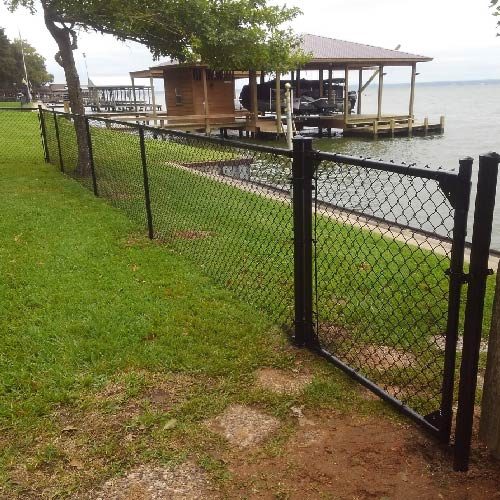
A fence built to keep a dog safe is a different job from a fence built for privacy or looks, even when it turns out to be the same fence. The real question is not "what fence do I want" - it is "what is this particular dog going to try, and will the fence still be standing when he tries it." A retired greyhound and a young cattle dog are not the same brief.
Here is how we think it through when a customer around Livingston tells us the fence is for the dog.
Start with the dog, not the fence
Before we talk materials at all, we ask about the animal, because escapes are almost always specific to the dog rather than to fencing in general.
Jumpers and climbers
A fit, motivated dog can clear a four-foot fence without much of a run-up, and some will climb chain link like a ladder. For these dogs, height is the first conversation, and a smooth face they cannot get a toe into matters more than the material.
Diggers
Others never look up - they go down. A digger will find the one soft spot along the whole run, usually in a corner or under a gate, and be through it in an afternoon. For a digger, what happens at ground level matters far more than the top of the fence.
Bolters
Then there is the dog who is not really trying to escape at all, but will shoot through any gate left open for three seconds to greet a visitor. That is a gate and hardware problem, not a fence problem, and it is one of the most common ones we hear about.
Height that actually holds
For most family dogs a solid six-foot fence is the safe default and takes the jumping question off the table entirely. Four feet is fine for a small or older dog with no interest in leaving, and it keeps a yard feeling open, but it is a gamble with anything athletic. If you are not sure which category your dog falls into, build for the more capable version - it costs far less than a second fence a year later.
Materials, dog by dog
Chain link
The classic dog fence for good reason: durable, economical over a long run, and the dog can see out, which keeps some dogs calmer. The trade-offs are that climbers can use the mesh, and it does nothing for privacy. Black vinyl-coated chain link looks far better than raw galvanised and all but disappears into a yard.
Wood privacy
A six-foot wood privacy fence answers jumping and climbing in one move, gives you a private yard, and - not a small thing with dogs - stops the dog seeing every person and animal that walks past, which is what sets a lot of barkers off in the first place. A dog he cannot see is a dog he is less likely to argue with.
Wire mesh and no-climb
For acreage and rural blocks, welded or woven wire mesh with small openings holds a dog without the cost of solid fencing over hundreds of feet. It is also the honest answer when you want to contain a dog and a little livestock behind the same line.
Wrought iron
Handsome and strong, but the bars are spaced, so iron suits a larger dog rather than a small one who can slip between pickets. If you love the look and have a small dog, the fix is a run of fine mesh along the bottom, which we can build in from the start.
The gaps that let dogs out
Nearly every escape we get called about comes down to a gap that was there all along:
- Under the gate. The ground is rarely flat, and the daylight under a gate is the first place a dog looks. A ground bar or a dug-in threshold closes it.
- Beside the posts. On uneven ground a stepped fence can leave a triangle of space at the bottom of each panel. It has to be planned for, not discovered later.
- Picket spacing. On any spaced style, the gap between pickets has to suit the smallest dog in the yard, not the biggest.
Beating the digger
If you have a committed digger, the fence has to continue below the surface. The usual answers are burying the bottom of the mesh, running a concrete or paver footing along the base, or turning a skirt of mesh inward underground so the dog digs down onto his own fence. It adds a little to the job and saves a great deal of worry - and it is far cheaper done while we are building than retrofitted later.
The East Texas summer
A fence is only half of keeping a dog safe here. Our summers are long and genuinely hot, and a securely fenced yard with no shade is not a kind place for an animal in July. When we lay out a fence we are happy to talk through where the shade falls and where a gate or a run should sit, so the dog has somewhere cool to be as well as somewhere safe.
Gates and daily life
The best dog fence in the county fails if the gate does not latch on its own. We fit self-closing, self-latching hardware as standard where there is a dog, and for driveways a proper gate - or an automatic one that is never left propped open - closes the biggest gap of all.
If you are weighing up materials more generally, our note on wood versus chain link versus wrought iron goes deeper, and the questions worth asking before you hire anyone apply doubly when a pet's safety is riding on the work.
We fence yards for dogs right across Lake Livingston and Polk County, and we are glad to look at your yard and your dog and tell you honestly what will hold. Ask us for an estimate and we will come measure.
Want a price for your property? Call (832) 279-1295 for a free estimate. See our fence and gate services, or find us in Livingston, Onalaska, Corrigan, Cleveland and across Polk County and the surrounding area.
Thinking about a fence this year?
We build across Polk County and the surrounding lake communities. Estimates are free and there is no pressure either way.
Request an estimate Call (832) 279-1295