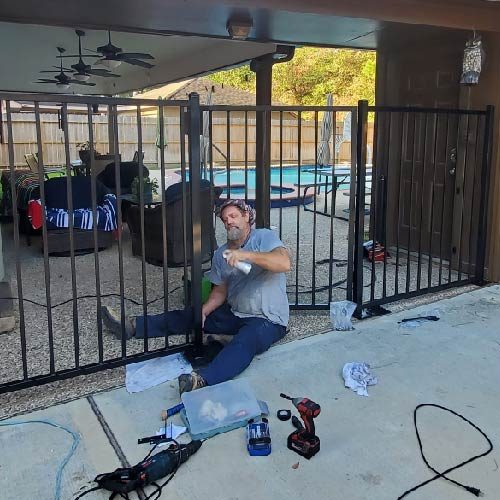
Most people only hire a fence contractor once or twice in their lives, so it is fair not to know what the process should look like. Knowing the steps ahead of time makes it easier to spot a contractor who is skipping one, and it makes the whole job a lot less stressful on your end.
Here is how a fence or gate project normally runs, from the first phone call to the day you walk the finished line, with notes on what to have ready at each stage. It applies whether you are fencing a back yard in Livingston, a lake lot near Onalaska, or acreage anywhere in Polk or San Jacinto County.
Step 1: The first call
The first conversation is short. A contractor needs to know roughly what you want (a new fence, a driveway gate, or a repair), where the property is, and how big the job is. You do not need exact measurements. A rough idea of the length and where the gates go is plenty to start with.
It helps to have a few things in mind before you call:
- What the fence is for. Privacy, keeping dogs or livestock in, security, or simply marking the line. The purpose decides the height and material more than anything else.
- Where the gates go. Think about mowers, trailers, and trucks, not just people on foot.
- Any rules you already know about. If you are in a subdivision with an HOA or deed restrictions, mention it early. Our article on fence permits in Polk County explains where those rules usually come from.
Step 2: The site visit
This is the most important step, and it is the one you should not let anyone skip. A fence cannot be priced properly from a satellite photo. When we come out, we walk the line with you, look at the ground, the slope, the trees and anything else in the way, and talk through materials, heights and budget on the spot.
Plenty comes up on a site visit that would never come up on a phone call:
- Slopes and dips, which decide whether the fence steps down or follows the grade.
- Trees, roots, and brush along the line that need clearing.
- Drainage paths and low spots that hold water after a heavy rain.
- An old fence that has to come out first.
- Where the property line actually is. Have your survey handy if you have one. If the line is uncertain, it is far easier to settle that now than after the posts are in the ground.
Try to be there for the visit. Ten minutes of walking the line together answers questions that would otherwise take a week of phone calls.
Step 3: The written estimate
After the visit you should get a written estimate for your actual job, not a per-foot guess. Ours are free and come with no obligation, and we would encourage you to get one from anyone else you are considering too.
A good estimate describes the fence clearly enough that you could hand it to another contractor and get a price for the same thing: the material and grade, the height, the post type and spacing, the gates and hardware, and whether tear-out and haul-off are included. If you are comparing several, our guide to what a fence costs in Polk County shows where quotes usually differ, and our 7 questions to ask before hiring a fence contractor are worth putting to every one of them.
Step 4: Saying yes and getting on the schedule
Once you accept an estimate, materials get ordered and the job gets booked. Before the crew arrives, it is worth asking:
- Roughly when the work will start and how many days it should take.
- Whether anyone needs to be home, and how the crew will get in and out (gate codes, locked gates, pets).
- Who arranges for underground utilities to be marked. In Texas that means a call to 811 before any digging, and it should be a routine part of the job.
- What happens if it rains. East Texas weather moves schedules, and a contractor who says so up front is being honest, not difficult.
Before install day, move anything along the fence line that you want to keep safe: planters, toys, firewood, and any vehicles parked near a gate opening.
Step 5: Install day
Most fence jobs go in a predictable order. The line is marked out, the old fence comes down if there is one, the post holes are dug, and the posts are set. Then the rails or wire go up, then the pickets, panels, or mesh, and the gates are hung last, once the posts that carry them are solid.
Expect some noise, some equipment in the yard, and some disturbed ground along the line. It is a construction job, even when it is a small one. If something on the ground looks different from what you discussed, ask about it while the crew is there. It is much easier to move a gate position on the day than after the concrete has set.
Gates and automatic openers usually take the most care. On a driveway gate, the posts, the gate, and the opener all need to be sized for one another, which is why we build the gate and fit the opener as one job.
Step 6: The final walkthrough
When the work is done, walk the whole line, ideally with the contractor. This is your chance to raise anything before the job is closed out. Here is what to check:
- Lines and tops. Look down the run from each end. It should be straight, and the top should follow the ground or step down evenly.
- Posts. Push on a few. They should feel solid, with no movement at the base.
- Gates. Open and close every one. They should swing freely, latch without being lifted, and not drag on the ground.
- Clean-up. The old fence, offcuts, and soil from the post holes should be gone, unless you agreed otherwise.
- Care and contacts. Ask how to look after your material (wood needs sealing or staining every so often, wrought iron needs the odd touch-up) and who to call if something needs attention later.
A small punch-list item at the end of a job is normal. What matters is that it gets fixed without a fight.
After the crew leaves
A fence is not quite finished the day the trucks pull away. Wood moves as it dries, ground settles after heavy rain, and gates sometimes need a small adjustment once they have been in use for a while. If something does go wrong down the line, from storm damage to a sagging gate, our fence repair service covers it.
Ready to start?
We build fences and gates for homes, lake lots, and acreage across Polk and San Jacinto Counties, including Livingston, Onalaska, and the rest of the Lake Livingston area. If you would like to see how the process works on your own property, ask us for a free estimate. We will come out, walk the line with you, and give you a real number for the job.
Thinking about a fence this year?
We build across Polk County and the surrounding lake communities. Estimates are free and there is no pressure either way.
Request an estimate Call (832) 279-1295