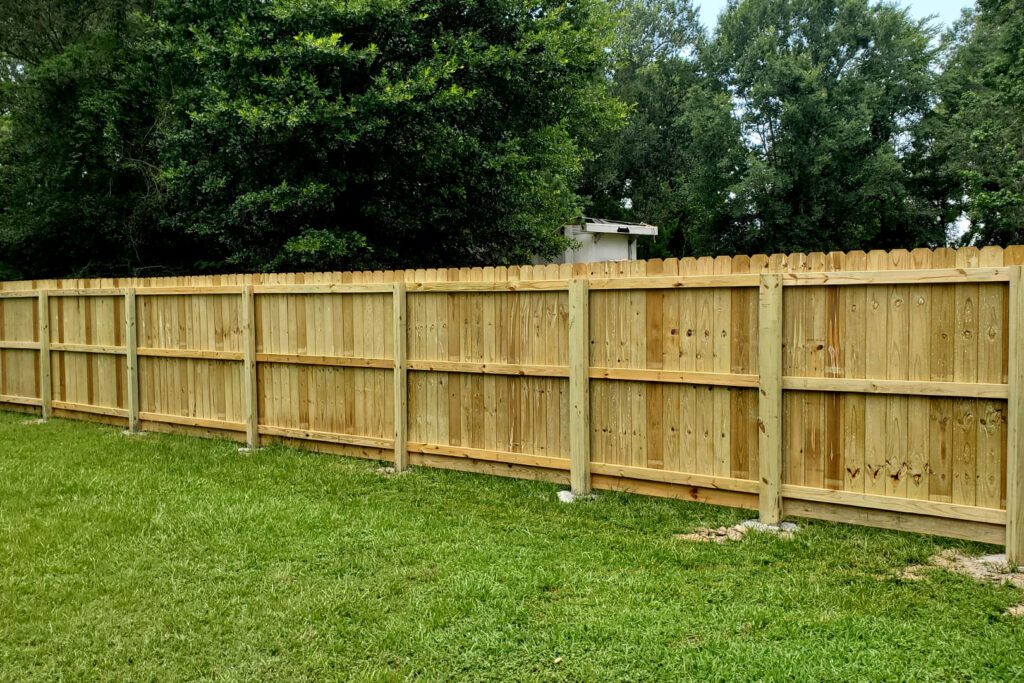
It is the first question almost everybody asks, and the honest answer is that a fence is priced like a small construction project rather than like a product on a shelf. Two houses on the same street can get quotes that differ by thousands of dollars for reasons that have nothing to do with one contractor being greedy.
Here is what actually moves the number, and how to read a quote so you can tell whether you are comparing two prices or two entirely different jobs.
What actually drives the price
Linear feet, not square feet
Fencing is measured along the ground, in linear feet. Before anything else, somebody has to walk the line and measure it. A back yard that looks small can run 200 feet once you go around the corners, and a few acres of perimeter can run well past 1,500 feet. This single number does more to set your price than the material does.
The material and the height
A six-foot wood privacy fence and a four-foot chain link fence covering the same run are not close in price. Going from six feet to eight feet in wood costs more than the extra two feet of picket suggests, because taller fences catch more wind and need heavier posts set deeper.
What the ground is doing
Flat, clear, and reachable by a truck is the cheap version. Around here it often is not that. Slope means stepping or racking the panels. Tree roots mean hand-digging. Sandy soil near the water and heavy clay a mile inland behave differently once a post is in the ground. If a machine cannot get to the line, somebody is carrying materials, and that is labour.
Gates
Gates are the most expensive few feet of any fence. A simple walk gate is modest. A double driveway gate needs heavier posts, proper hardware, and square framing that will not sag in five years. Add an automatic opener and you are adding an electrical or solar system with its own cost.
Tear-out and disposal
If there is an old fence, it has to come out, get loaded, and go somewhere. Old posts set in concrete are slower to remove than the fence itself. Some quotes include this and some quietly do not, which is one of the most common reasons two bids look different.
Typical ranges
These are broad ranges for this part of East Texas as of 2026, meant to help you budget rather than to price your specific job. Material costs move, and every property is different.
- Chain link is usually the least expensive per foot, and black vinyl-coated chain link costs somewhat more than galvanised.
- Wood privacy sits in the middle, with pressure-treated pine at the lower end and cedar noticeably higher.
- Split rail and wire mesh are economical over long agricultural runs because there is far less material per foot.
- Wrought iron is the most expensive per foot, and custom ironwork more so again, because it is fabricated rather than assembled.
Rather than quote a per-foot figure that will be wrong for half the people reading it, we would rather walk your property and give you a real number. It is free, and there is no obligation attached to it.
The costs people forget
- Corners and ends. A fence with many corners costs more than a straight run of the same length, because corner and terminal posts carry the load and are built heavier.
- Concrete. How much goes in each hole, and how deep the hole is, is a real cost and a real quality difference. It is also invisible once the job is done.
- Clearing the line. Brush, small trees, and old wire have to be dealt with before a post goes in.
- Utility locates. Before anyone digs, underground lines have to be marked. That is a phone call to 811, it is free, and it is not optional.
How to compare two quotes properly
Put them side by side and check that they describe the same fence:
- How deep are the posts set, and are they set in concrete?
- Are posts wood or steel, and what spacing?
- What grade and species of lumber, and is the hardware galvanised or stainless?
- Is tear-out and haul-off included?
- How many gates, what size, and what hardware?
- Is there a written warranty, and what does it actually cover?
A cheaper quote is sometimes genuinely cheaper. More often it is a shallower post, a thinner picket, or a line item that was left out and will reappear later. The questions worth asking before you hire anyone are a good companion to this.
Where the money is well spent
If you have to economise, do it on the visible parts rather than the structural ones. A shorter fence, a simpler style, or a less expensive picket are all reasonable savings. Shallow posts, undersized hardware, and skipped concrete are not - those are the things that have you replacing the fence years earlier than you should.
We build across Polk County and the surrounding communities, and we are happy to talk through options and budgets before you commit to anything. Ask us for an estimate and we will come measure.
Thinking about a fence this year?
We build across Polk County and the surrounding lake communities. Estimates are free and there is no pressure either way.
Request an estimate Call (832) 279-1295