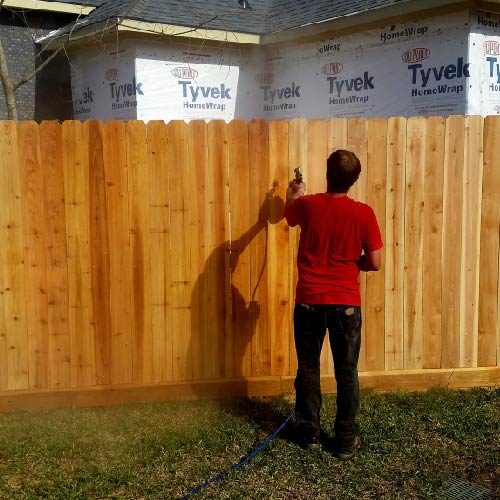
We do not get the headline hurricanes this far inland very often, but anyone who has spent a summer around Lake Livingston knows we get the wind. Thunderstorm gusts, the trailing edge of tropical systems tracking up from the coast, and the odd straight-line blow all put a real load on a fence. The fences that come through it are not lucky - they were built for it.
Here is what actually decides whether a fence stands or leans after a hard night, and where the money is worth spending if wind is on your mind.
Where fences actually fail
A fence almost never fails in the middle of a panel. It fails at the posts, and it fails because of wind load - and those two are really the same story.
The posts let go
When a fence blows over, the posts have usually pulled or snapped right at ground level. Either they were not set deep enough, they were not set in enough concrete, or the concrete never properly keyed into the soil. Everything above ground is only as steady as what is below it.
The fence becomes a sail
A solid privacy fence is, in a strong gust, a large flat sail bolted to the ground. That is not a reason to avoid privacy fencing - it is a reason to build it on posts that respect the load. The taller and more solid the fence, the more wind it catches, and the heavier its posts and footings need to be.
Post depth and concrete - the part you cannot see
This is the single biggest difference between a fence that stands and one that does not, and it is completely invisible once the job is finished, which is exactly why it is the corner most often cut. A post set a foot deep in a shovel of dry mix will pass a handshake and fail a storm. The same fence on posts set well down, in a proper volume of concrete that widens at the base, will still be standing when the branches come down around it. When you compare two quotes, this is the number to ask about - not the picket, the post.
Wind, and the privacy-fence paradox
The fence people most want here - a six-foot wood privacy fence - is also the one that catches the most wind. There are three honest ways to deal with that, and we will talk you through which suits your site:
- Build the posts for it. Heavier posts, deeper and in more concrete, so the sail has something solid to push against. This is the usual answer and the most reliable.
- Let some wind through. A shadowbox or spaced-picket style reads as solid from an angle but leaves small gaps for air to pass, taking load off the whole fence. It trades a little privacy for a lot of resilience.
- Pick a style the wind ignores. Where privacy is not the point, an open fence barely notices a gust at all.
How each material takes a blow
Chain link and wire mesh
Wind passes straight through chain link and wire mesh, so they carry very little load and are among the most storm-tolerant fences you can build. Their weak point is a top rail bending under a fallen limb rather than the wind itself.
Wood privacy
The most exposed to wind, and the most dependent on good posts. Built properly it is fine here; built cheaply it is the fence you see leaning in the neighbour's yard. Fixings matter too - screwed rails and pickets hold far better than nailed ones once the whole thing starts to flex.
Wrought iron
Heavy, rigid and open, so iron shrugs off wind and is very hard to knock down. Its enemy is a large falling tree, which is a different problem than the storm itself.
Split rail
An open split rail run gives the wind almost nothing to grab, which is part of why it lasts so well over long rural boundaries.
Trees are the real hazard
In this part of East Texas the thing most likely to flatten a section of fence is not the wind at all - it is a pine limb coming down on top of it. No fence laughs off a falling tree, but you can plan around them: keeping the line a sensible distance from big overhanging limbs where the layout allows, and choosing a material that is quick and cheap to repair in a spot you already know is exposed. Sometimes the right call is a run of chain link under the trees and the handsome fence where nothing can fall on it.
Gates in high wind
A wide driveway gate is a sail on a hinge, and one left open in a storm can wrench its own posts or slam hard enough to damage itself. Heavy hinge posts, a drop rod or cane bolt to pin it, and - for automatic gates - closing it before the weather arrives all save you a repair bill.
After the storm: repair or replace
When a fence does take damage, the question is whether to patch it or start over, and it usually comes down to the posts. A few broken pickets on sound posts is a cheap afternoon; leaning posts and cracked concrete along a whole run are often a sign the fence was under-built to begin with, and money spent patching that is money you will spend again next season. Our note on repairing versus replacing a fence walks through how to tell the difference, and how long a wood fence really lasts here is worth a read if yours is getting on.
We build fences to stand up to what the weather around Lake Livingston and Polk County actually does, and we are happy to look at an exposed site and tell you where it needs strengthening. Ask us for an estimate and we will come measure.
Want a price for your property? Call (832) 279-1295 for a free estimate. See our storm damage repair, or find us in Livingston, Onalaska, Corrigan, Cleveland and across Polk County and the surrounding area.
Thinking about a fence this year?
We build across Polk County and the surrounding lake communities. Estimates are free and there is no pressure either way.
Request an estimate Call (832) 279-1295