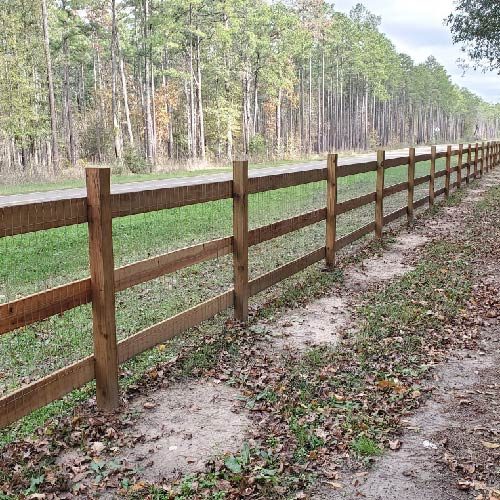
Fencing acreage has almost nothing in common with fencing a back yard. The runs are long, the budget is judged per foot rather than per job, and the fence has to do actual work - containing animals that will lean on it, push through it, or test it every day.
Getting it right starts with being specific about what you are containing.
Match the fence to the animal
Cattle
Cattle push and lean rather than jump. What matters is strength and the height of the top wire or rail. Barbed wire is the traditional and economical answer over long perimeters. Pipe corral fencing is what you want at the working pens, where animals are crowded and the pressure on the fence is far higher.
Horses
Horses are the animal most likely to be injured by the wrong fence. Barbed wire and horses are a poor combination - a horse that gets a leg through it does serious damage to itself. Pipe, rail, or woven wire with a visible top rail are all safer. Visibility matters: a horse needs to see the fence to respect it.
Goats and sheep
Goats are the hardest animals to contain, and everyone who has kept them knows it. They climb, they push through gaps, and they will find the one weak point in a perimeter. Woven wire mesh with small openings and tight spacing is the practical answer, and the bottom needs to be secured properly to the ground.
Keeping wildlife out
Protecting a garden, orchard, or food plot from deer is a height problem more than a strength problem. That usually means taller mesh than a livestock fence.
Where the cost actually goes
On acreage, the material per foot is only part of it. The parts that decide the real price are:
- Corners and braces. A wire fence is only as good as its corner assemblies, because those carry all the tension. Properly built H-braces at corners and ends are what keep a fence tight for decades. Skimping here is why a fence sags after two seasons.
- Post spacing. Wider spacing uses fewer posts and costs less, but the fence is weaker. It is a genuine trade-off rather than a corner to cut blindly.
- Clearing the line. On raw acreage this can be a real share of the job. Brush, small trees, and old wire have to come out first.
- Terrain. Creek crossings, gullies, and rock all slow a job down and all cost money.
- Gates. Think about equipment, not just animals. A gate that a tractor or trailer cannot get through comfortably is a gate you will resent every week.
Plan the layout before the fence
The most expensive acreage fencing mistake is not the material - it is fencing the wrong shape. Before anything goes in the ground, think about:
- How you will rotate pasture, and whether you want cross-fencing to make that possible later.
- Where water is, and whether every paddock can reach it.
- How you move animals between areas, and whether the gates support that flow.
- Where equipment needs to travel, and how wide those gates need to be.
- Whether you might subdivide or add stock later.
Adding cross-fencing later is straightforward. Moving a perimeter is not.
Perimeter and pens are different jobs
It is normal and sensible to use two different standards on the same property. A long perimeter in barbed wire or woven wire, and heavy pipe at the working pens and loading area where the pressure is concentrated. Building the whole property to pen standard costs far more than it needs to; building the pens to perimeter standard does not hold.
We fence acreage across Polk County and the surrounding area, from a few acres to full perimeters. Get in touch and we will come walk it with you.
Thinking about a fence this year?
We build across Polk County and the surrounding lake communities. Estimates are free and there is no pressure either way.
Request an estimate Call (832) 279-1295