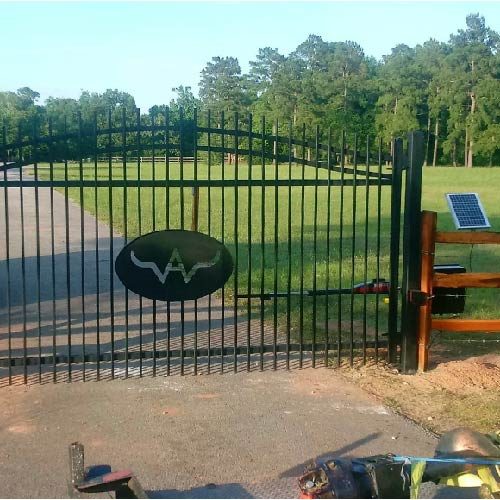
An automatic gate needs power, and on rural property that is the part people have not thought about. The gate is at the road. The house, and the electricity, might be several hundred feet away. What happens next decides a meaningful part of your budget.
The real question is the trench
Running mains power to a gate means burying conduit from the nearest supply out to the entrance. The gate opener itself is not the expensive part of that - the digging is. Cost scales with distance, and it goes up further if the run has to cross a driveway, a culvert, tree roots, or anything else that resists a trencher.
A short run from a nearby outbuilding is often inexpensive and worth doing. A long run across difficult ground can cost more than the entire gate and opener combined. That is the crossover point where solar stops being the compromise option and starts being the sensible one.
When solar is the right answer
- The gate is a long way from power. This is the main one, and it is common on acreage.
- The entrance gets real sun. A panel needs several hours of direct light. Heavy tree cover over the gate is the thing that sinks a solar installation, and it is worth being honest about before you commit.
- Traffic is normal residential volume. A gate that opens a dozen times a day is well within what a properly sized solar system handles.
- You want it working when the power is out. A solar gate runs off its battery, so an outage does not strand you at your own entrance.
When mains power is the better choice
- Power is already close. If there is a supply within a reasonable distance, the trench may be cheap enough that mains is simply better.
- The gate is shaded. No amount of sizing fixes a panel that does not see the sun.
- High traffic. Commercial entrances, or a gate cycling constantly all day, favour mains.
- You are running other things at the entrance. Lighting, cameras, or an intercom add load, and at some point a supply is simpler than growing the solar system to match.
Things worth knowing either way
Swing gates and slide gates behave differently
A swing gate needs room to open and reasonably level ground through its arc. A slide gate needs room alongside the opening to slide into, and is the usual answer where the driveway slopes upward from the road or space is tight. The choice affects which openers suit and how much power the system draws.
Safety equipment is not optional
An automatic gate is a heavy moving object. Photo eyes and safety loops stop it closing on a vehicle, a pet, or a child. Anyone who quotes you an automatic gate without safety devices is quoting a cheaper and worse installation.
Plan for getting in when it fails
Every automatic gate should have a manual release you can operate from outside, and you should know where it is before you need it. Batteries age and controllers fail eventually.
Decide how people get in
Keypad, remote, phone-based control, or an intercom - each has a cost and each suits a different household. Think about deliveries and visitors, not just yourself, because that is where a gate becomes either convenient or annoying.
The gate has to be right first
An opener is only as good as what it is bolted to. A driveway gate that sags or racks will drag, bind, and wear the opener out early. The posts either side carry the whole weight of the gate plus the force of the operator, and they need to be set for that. This is why we would rather build the gate and fit the opener as one job than automate somebody else's gate that was never built for it.
We install both solar and mains-powered systems throughout Polk County and the surrounding area, and we will tell you honestly which one your entrance suits. Ask us to come and look - the answer usually becomes obvious once we can see where the power is and how much sun the gate gets.
Thinking about a fence this year?
We build across Polk County and the surrounding lake communities. Estimates are free and there is no pressure either way.
Request an estimate Call (832) 279-1295